Monday, April 28, 2014

Longing for Home book review

Longing for Home (A Proper Romance, #2)

Longing for Home 

 
Twenty-six-year-old Katie Macauley has placed all her hope in Hope Springs, a small town in the 1870 Wyoming Territory. But if she wants to return home to Ireland to make amends with her estranged family, she'll need to convince the influential Joseph Archer to hold true to his word and keep her on his payroll as his housekeeper despite her Irish roots. The town is caught in an ongoing feud between the Irish and the "Reds" the frontiersmen who would rather see all the Irish run out of town and the Irish immigrants who are fighting to make a home for themselves in the New World. When Joseph agrees to keep Katie on as his housekeeper, the feud erupts anew, and Katie becomes the reluctant figurehead for the Irish townsfolk. As the violence escalates throughout the town, Katie must choose between the two men who have been vying for her love though only one might be able to restore hope to her heart.


My Review: 6.75/10

*Spoilers ahead!*

My very first thoughts on reading this book were not favorable; the opening chapter that sees Tavish and Ian giving Katie a ride did not impress me. I thought Tavish's thoughts and comments were repetitive and based on nothing. Not to mention the way he kept stating the obvious. Tavish was way too interested, way too soon. I just didn't find it believeable. I was about ready to turn this one in as one I couldn't finish, but for some reason, I pressed on a little longer. I'm glad I did.

While Tavish never gives up on his relentless pursual of Katie, you quickly spend a lot less time in his head, which makes his interactions more charming than shallow.

Ms. Eden does a good job of providing hard choices and real struggles. Romantically, it didn't seem like an easy choice for me, except for the fact that Joseph wouldn't let Katie know of his feelings. But there was plenty to love in them both, from her point of view.

Her ultimate choice between Hope Springs and Ireland was not an easy one either.

And no easy solutions for the problems in Hope Springs were offered either.

And then, we finally get the whole tale of Katie's past. That's not easy either. The way it was built up, I kept expecting the author to have built in a loophole, something that would remove all blame and guilt from Katie's shoulders, where her family was concerned. I expected it, but it never happened, fortunately. Her past was understandable, but she still placed reasonable blame on herself. I was really proud of Ms. Eden for giving her characters real problems, real struggles, real regrets. These things build character in a person, making them interesting, unique, and hopefully full of integrity and strength. She allowed Katie the time to earn the reader's compassion and respect. That is not easily done nor common enough.

I rated this book the way I did because though I enjoyed it (I really loved the Irish infusion, the dialogue, the history, the details, everything. So well done!) and thought so much of the plot and characterization well done, I had a criticism for every compliment.

I didn't understand why Joseph thought he could court Katie after she moved out. How did he think that would go with the Reds? Seems to me it never crossed his mind, which was totally out of character.

And with all the power Joseph held, and he held it all, why did he not demand peace, require civility, fair prices, no violence/harassment, etc as part of terms of lease? If anyone violated it, they would be given a warning and then, if it continued, they'd be evicted. Seems plenty simple to me.

Why were there no lawmen to enforce anything? I understand that it was a territory, but if they could have a church with a pastor, they could have a sheriff or deputy or something and a jail, even if it was only a one room holding cell.

Why did it not occur to Katie herself to ask Granny about staying there, especially as she'd just spent time with her, reflecting on how much help Granny needed?

At the time, I was wondering why there was so little reference to God and why Katie didn't pray and seek out the Bible for answers, and now I'm thinking, this may not have been a Christian based novel. I'm not sure, so I'm going to discount that.

When it came down to it, I thought Katie flipped from being annoyed with Tavish to being super into him, just a little too quickly. If I remember correctly, it really happened when he saved her by dancing in her stead. I thought that was well done, certainly the kind of thing to turn a girl's head. But Katie seemed to flip too easily (and often) in general for me. First Tavish, then Joseph and back and forth and back and forth (though it did seem that her preference for Tavish was always stronger and present, which appeased me). Then it was leaving Hope Springs, then talk of staying for years, then leaving, then staying, then leaving and ultimately staying. Too much, too easily flip flopping. Perhaps this was supposed to be a character flaw of hers. I'm not sure.

Ultimately, I enjoyed this book. It was interesting, stuffed with history and authenticity, and a sobering taste of realism. The things I loved and the things I thought could have been better put aside, the book left me wanting more. Will Katie ever learn to read? How will the Reds and Irish find peace? What will happen with Katie's family? What will happen with the new housekeeper? What will happen with the Archer family? What will happen way down the line with Finbarr? These are just a smattering of the things I'm dying to know and the character's I'm invested in. This book will draw you in and hold tight.

Tuesday, April 22, 2014

An Untamed Heart book review

An Untamed Heart

An Untamed Heart 

by
 
The Long-Awaited Prequel to the RED RIVER OF THE NORTH Series
Twenty-year-old Ingeborg Strand is certain she is destined to be an old maid. She's had several suitors but none she deemed worthy of spending her life with. That is, until she meets a university student from Oslo, and feelings stronger than friendship begin to develop between them. But tragedy strikes, and the future begins to look bleaker than ever.
Grief settles heavily over Ingeborg, and her mother suggests that she leave Norway and start afresh in America, as so many others have done before her. But how will she accomplish that with little money and no one to accompany her?
It isn't long before she meets Roald Bjorklund, a widower who has been planning to go to America for some time, lured by the promise of free land. He's a good man, a hard-working man--and he has a young son who desperately needs a mother. He's clearly interested in Ingeborg, but is he the answer to her prayers? And what about love? This isn't how she's always imagined it.
Ingeborg Strand has a heartrending decision to make...


My Review: 1/10

Full disclosure- I skimmed a lot and didn't finish it.

I realize it's kind of petty to take issue with a book because of something like names, and the author was being authentic to the culture, but she didn't have to choose names like Ingeborg and Gunlaug for the main characters... even Ingeborg's sisters had better names. Lots of heavy G and R sounds which made it hard to chew through.

But I could overlook this if I fell in love with the characters or even found them mildly interesting. But I just didn't understand them. It seemed to me that there were a lot of (immediately) contradicting thoughts and actions from Nils and Ingeborg. One minute she's saying she won't put her brother in the same position she's been put in (matchmaking) and then all of sudden she's forcing them to dance. I had a lot of "what? what just happened?" moments when reading.

Also, several characters (like Nils and Ingeborg) were constantly frustrating me because they dwelled a lot on their problems but were always avoiding confrontation or being passive aggressive. I don't have respect for people or characters who whine about their circumstances and are unwilling to adress the problems head on. Both should have just spoken to their parents and then heard them out. Maybe it was a cultural thing.

The narrative was a little weird and confusing for a while- we'd switch back and forth between mar/Hilde etc. and characters would refer to themselves as if they were speaking about someone else ("did he think her daughter...")

Overall, there was lots of dialogue, but not much being said, lots of actions being described, but nothing really happening.

Tuesday, April 8, 2014

Caught in the Middle book review

Caught in the Middle (Ladies of Caldwell County, #3)

Caught in the Middle 

by
 
The train to Garber, Texas, is supposed to bring life's next victory to Nicholas Lovelace. Instead, it gets held up by robbers who are thwarted by the last person Nick ever expected--Anne Tillerton from back home in Prairie Lea.

Anne’s been hiding away as a buffalo hunter. She’s only in Garber to find their runaway cook, but the woman flees--leaving Anne with her infant son. With Nick the only person Anne knows in Garber, the two form an unlikely team as they try to figure out what to do with the child.

But being in town means acting and dressing for polite society--and it's not going well for Anne. Meanwhile, Nick's work is bringing new pressures, and being seen with a rough-around-the-edges woman isn't helping his reputation. Caught between their own dreams, a deepening relationship, and others' expectations, can the pair find their way to love?


My Review: 9/10


I was so excited when I saw that Regina Jennings had a book coming out this month! I first heard of her just a couple of months ago when reading A Match Made in Texas. Unexpectedly, hers was my favorite short story in the set and I took note of her name, determined to keep an eye out for her work. I had such high hopes for this book and Ms. Jennings did not disappoint.

I had no idea this was part of a series. It worked just fine on its own. Although, if you'd read the previous books, you'll probably better appreciate updates on and the involvement of previous characters.


The best thing about this book was the abundance of interesting and realistic characters. I always love a hero that is unapologectically (at least for a time) imperfect because that is relatable. Our flaws lead to struggles which develop our character. I cannot admire or believe in characters that are portrayed as perfect. And Ophelia. Oh my. She was deliciously obnoxious. I loved some of the ways she was described, such as: Using her parasol as a walking stick, she made her way to the customary chair and sank into it like a queen on her rival's throne." (page 172)  I was amazed at Anne's calm demeanor when Ophelia constantly spoke about her as if she wasn't there at all and the way Nick let her. I appreciated being able to see his struggles in those moments.

I thought Ms. Jennings captured the human heart so well when Finn is discovered and Anne is left with an immediate and impossible choice. The bond between Anne and Sammy, the change occurs so naturally. Being orphaned, or living like it with unavailable parents was so common back then, so it is a common theme in books placed in this time period. To me, 99% of the the time, they are trite; just a subplot used to characterize the heroine as unfailingly compassionate and sacrificial and feminine so that her love interest is inexplicably drawn to her. But Ms. Jennings work is the exception, not the rule. I loved the line "Anne watched the quiet house as she silently buried her dreams of independence." She did not enter into this with excitement and joy and because of a love for all children. Anne enters into this terrified, but for the love of this one child. And I thought it was even more important that Nick did not fall for her because of her bond or sacrifice for Sammy. How refreshing that a love was built many layers deep, starting out with respect.

Touching on subjects of abuse, especially at this level, and healing can be very tricky. I thought Ms. Jenning did a wonderful job throughout and I particularly loved her description of Nick's handling of her: "Nick smiled. Anne could grouse all she wanted. She was there and she was dressed respectfully. He wouldn't expect much more from her. Incremental change, gradually increasing the grade- that's how trains got from swamp to mountaintop. You couldn't go steep, especially carrying a load as big as the one Anne toted." (page 159) How perfectly put. Nick's determined and steady work on Anne, his patience and perseverance were a perfect blend and seemed very true to his personality. Their's was a beautiful love story to watch unfold.

The scene in Ophelia's dining room was entertaining and not needlessly so. I thought it was an excellent portrayal of a woman with a history of abuse. And I loved Nick's response. I come across a lot of authors who give their characters a history of some kind of pain/suffering and only seem to pull it out when they want to make their character vulnerable so that the lovebirds can bond. Ms. Jennings creates consistent characters that are true to form, even when things become uncomfortable, messy or downright unbearable.

I loved the moment Nicholas realized he was in love with her. Unique. Natural. Simple. Exquisite.

I could go on and on and on about the things I loved in this book- well-time and placed humor, the arguments between Nick and Anne that represented both sides well, the challenges to living out Faith, struggles with prioritizing integrity over prosperity, etc. But this book is so well done, you just have to read it. You'll find yourself constantly taking notes, dog-ear-ing, highlighting and underlining, and returning often reference a concise, well put line or two.

The only criticisms I had were brief and small in comparison: the bridge drama that happens early on- it seemed senseless to me that the man would charge headfirst into certain drowning. I thought, geez, that is the last thing his wife needs right now. And it appeared to be due to pride/ego rather than service. But then he didn't drown and I thought, I must have misunderstood the situation. I'm not sure on that, but I think the points could have been made (family first, love, need of the bridge etc) without it being quite so dire and dramatic.

The other issue I had was just with the plot. When Anne/everyone found out that Sammy's grandparents wanted him, my first thought was, "oh, I guess she's going to have to seek out Tessa afterall." I mean, it didn't matter if grandparents were of closer kin, if the mother put her child in the care of someone else. Her claim was sound. And in the beginning, she remarked that she could easily track wherever Tessa went next, there just wasn't any point. So I thought, she should just get Tessa to write something that is legal and binding. So it was a little mind boggling to me, the desperation and events that followed.

Bottomline, this is a book I will read and reread often and delight in every time. I think I've found a new author to love!

Sunday, March 30, 2014

A Heart's Rebellion book review

A Heart's Rebellion

A Heart's Rebellion 

by
 
Dutiful Jessamine Barry is tired of waiting patiently for a man to decide her future. So even though Lancelot Marfleet, second son of an aristocrat, is taking an interest in her during the London season, she refuses to consider him as a suitor. Instead, she's ready to take fashionable society by storm--and finds a rakish young man all too willing to help her do it. When things go too far, Jessamine will learn that the man who is faithful through thick and thin is more worthy than the one who speaks pretty words. But will her disgrace keep Lance from reconsidering her as a wife? And when tragedy strikes and Lance becomes his father's heir and a titled gentleman, will he think she only wants him now because of his title?


My Review: 6/10 

I did not realize that this book was a sequel until I was already knee deep in it. While it stands alone fairly well, I wonder if my perception of a few key characters would have been different if I had read the first book.

As it was, Jessamine and I did not get on. At all. She spent a good portion of the book being caught up in whining, self-pity, and pining after another woman's man. Oh my. It was difficult to swallow. Like a raw egg.

Her behavior toward Lancelot was just awful. She was shallow and stuck up, immediately dismissing him because of his looks. After realizing who he was, I expected her to be mortified and humbled. But no, she was all pride and conceit, thinking herself better than him.

As the story went on, her self-involvement reached a peak with her blaming everyone else for her feelings and obsessions, as if she is purely a victim of her circumstances. She may have been at one time, but at this point she is choosing her own self destructive path. She is no victim. Even when Megan tries to gently direct her to God, telling her to trust in His plans for her, she hardens her heart and persists.

Jessamine's attitude and actions may be an accurate representation of how some people really think and behave but they are not people I could respect or stand to be around much.

That being said, I did sympathize with her on a few points; overhearing the brief words between Rees and Celine was humiliating. I cannot even imagine. Rees in general seemed to be rubbing it in her face from the beginning all the way to the end with his talk of wishing she had found a love like he had with Celine. Why did he feel the need to compare the two? Why talk about himself at all?

I also understood the root of her insecurities, the cause and effect; her comparing herself to Celine and trying to compete, her seeking out what consoled her bruised ego, even why she was repulsed by a man who seemed too timid and was too similar to both her father and former intended, both of whom she blamed. What I didn't understand is why she thought she was superior to him or even equal to him, why she was so confident in her own appeal that she felt the need to rebuff his advances from the very first.

It was her total lack of humility and over abundance of insecurities (which I believe drove her constant defensive position at every interaction with Lancelot. I prefer characters who have a sense of humor; Jessamine was constantly irritable and offended.) that kept me from being able to connect with her or believe in their romance.

As a side note, I wasn't sure what to make of the drugging episode. Initially it rubbed me the wrong way because it seemed way too modern and out of place. Did that really happen back then? It would seem so, considering that Lancelot referenced a drug he was aware of. The author must have done her homework here. If that's the case, it just seemed too extreme and poorly contrived that he would have the nerve to drug her and make off with her in public. Perhaps he'd thought her defenseless before, but after Celine's arrival, and their connection, I'd have thought the former Lady Wexham's position and influence would have been enough to end any dishonorable schemes.

This is the first book I've read by Ms. Axtell and though I would have preferred to closely follow Megan's story rather than Jessamine's, and I will likely not read the next book (Delawney?), I might just go back and read the first book. Celine appears to be a protagonist who is classy, intelligent and generous. She fell in love with a man because of his honor and respected that, rather than trying to dissolve it- my kind of heroine, my kind of love story.

Saturday, March 29, 2014

The Reaver: The Sundering, Book IV book review


The Reaver (The Sundering, #4)

The Reaver 

by
 
In the 4th book of the multi-author Sundering series launched by New York Times best-selling author R.A. Salvatore, Richard Lee Byers introduces Anton Marivaldi—a renowned reaver with an insatiable thirst for bounty and a moral compass that always leads him toward the evil he’s never tried.

Endless, pounding rain afflict the Sea of Fallen Stars and the coastal regions surrounding it. Harvests are failing, travel and trade are disrupted, and civilized forces are giving way to the deluges caused by the storms. In panic and despair, many have turned to the goddess Umberlee, Queen of the Deeps, offering her sacrifices with hope that they will be spared the inevitable reckoning of her perpetual tempest.

Evendur Highcastle, undead pirate captain, risen from the depths to assume the mantle of Umberlee’s Chosen, takes advantage of the people's desperation to strike for both spiritual and temporal power in her name.

Vying with Highcastle for the hearts and minds of the people is Stedd Whitehorn, a little boy and the chosen of a god thought lost to time: Lathander, the Morninglord. In a time of such upheaval, Stedd’s message of renewal and hope runs in stark contrast to the savage ethos of Highcastle and his waveservants.

When Anton captures the boy in order to collect Highcastle’s considerable bounty, the reaver is quickly caught in the riptide caused by the sundering of worlds.


My Review:  7/10
By Jonathan Armstrong

Richard Lee Byers came up with a fun and imaginative tale, but fell short in traditional writing areas that, unfortunately, undermined it.  Even still, I would probably re-read the book some day; it’s pleasurable and its tone is light. I would consider it a not-so-guilty pleasure.

Honestly, not knowing the author’s background or having read any of his other books, he reminds me of someone who created good adventures in a game like Dungeons & Dragons, was encouraged by the players, and then decided to turn those adventures into writing without being trained (or self-taught) in the mechanics of writing. The bad was mostly the result of writing mechanics (which can be improved) and the good was from the actual story. In other words, Richard Byers has a story to tell that’s worth listening to, but he needs to improve on how he tells it.

The first thing that struck me when I was reading was how cliché Anton Marivaldi seems in the opening of the book: a pirate captain lusting after treasure, caring nothing about his crew, and seeking his own adventure. There was a glimmer of hope that he could be deepened as a character when we discovered that he is threatened by depression after combat, but that was never really built upon. To be certain, we find out more about his past, but we didn’t get it in small doses or in a climactic reveal scene. We got it in a pretty anti-climactic fashion, actually. I will get to what made it that way later in the review.

Umara Ankhlab, a wizard(ess) of Thay, is the other unlikely hero of the book. Hers is an interesting story, which I enjoyed and have no complaints over. The way her vampire master made her willingly surrender to his bite well characterized both Umara and her vampiric overlord. In fact, it was a perfect representation of Umara’s spirit in the current hierarchy of Szass Tam’s Thay.

Here is my first complaint: the companionship between Anton and Umara was not earned by the writer. Their camaraderie developed way too quickly and way too easily with few obstacles. Realistically, when considering that one is a reviled pirate, one is a red wizard of Thay, they are both trying to kidnap the same child for different gains, and their companionship was actually based on positive moments shared together instead of shared evil motives, there should have been a trilogy’s worth of obstacles to overcome to get them there. Take their first scene together as an example. Sure, they both needed to get out of the temple and do so with Stedd Whitehorn in tow, but was there no distrust? If you and another party both infiltrate a temple to try and steal a child, you should have two goals once the alarms sound: get out with Stedd, and leave the other party to take your fall.  However, if we are accepting that the dire circumstances within the temple caused the two parties to fight together because they were too desperate not to, I would expect that to end soon after. It did, when Umara’s vampire master killed the rogues that Anton made a deal with. But Anton and Umara? Nope. Umara was ordered to stay behind to fight a celestial by herself, even though it would surely kill her, and she agreed because she had to listen to her vampiric master. But then Anton inexplicably decides to stay behind and help her…and then shortly after he and Umara are comrades-in-arms the rest of the book, with only circumstantial, token resistance to companionship between them.

The easy bonding between Anton and Umara is only saved by one thing:  Stedd Whitehorn. The child Chosen of Lathander has Biblical comparisons, which I won’t go into detail about. Suffice it to say that Stedd is most often concerned with a) preaching hope and the return of Lathander to the world in a time of darkness, b) preventing the rise of darker forces like the followers of Umberlee, c) following the revelations of Lathander, and d) bringing out the good in even the “unredeemable” such as a wizard of Thay and a villainous pirate. Richard Byers did a good job of creating opportunities to show how Anton and Umara were slowly changing—slowly finding hope, slowly reversing course on previous life choices—as a result of being with Stedd. This would have been an easy part of the book to force, but fortunately this aspect of the book was well done. Anton and Umara at first chased after Stedd because he was worth money or advancement to their own interests, but they eventually found themselves drawn to his message of light and his willingness to see good in them. Stedd gave them hope not just for their circumstances, but also for their own selves. The only realistic foundation for Anton and Umara’s companionship centered around Stedd. Their companionship made little sense when Stedd wasn’t involved, but when Stedd was, their relationship was beautifully formed. In fact, Stedd Whitehorn was a wonderfully done character overall; this character is responsible for the uplifting and spiritual tones of the book that would make me want to re-read it again some day.

An additional note, Stedd’s different roles as a typical child and a powerful Chosen were perfectly intermixed in his behavior. I also appreciated how Stedd came from the camp that Farideh and company freed at the end of the third book in the Sundering series.

Now to the anti-climactic scene where Anton’s past is revealed. This was poor, poor dialogue. First off, Umara asks about Anton’s past and Anton is way too open to revealing it (following the too-easy relationship pattern). There should be some greater barriers here. But regardless, the resulting conversation is mechanical, formulaic (and bad) writing. Anton delves into a recounting of his youth which consists of about a short paragraph’s worth of information. Then Umara says a one-line sentence or question that has no purpose but to transition to the next part of Anton’s story. Then another short paragraph of information. Then another one-liner. Rinse and repeat. There was no real interaction here. There was no emotion, interest, or reaction from Umara in any of the lines she said. Umara’s lines were only for the sake of continuing Anton’s tale. It was a wasted opportunity.

There were some other good points to this story (the different representations of Umberlee, Umberlee’s undead pirate Chosen, the different landscapes and unexpected adventures resulting from their travels) which I would talk about if I hadn’t written so much already. Without delving into them, I will simply say that the different plot points and combat scenes were inventive and interesting.

The combination of all this good and bad produced a light, maritime adventure. This was a good read, but could have been much better. It might be the equivalent of beach reading where Forgotten Realms is concerned. Here is to hoping that Richard Lee Byers fixes some of the issues that undermined this book before he publishes his next. Even if it’s not written well, I am interested to see where Stedd, Umara, and Anton end up.

Thursday, March 27, 2014

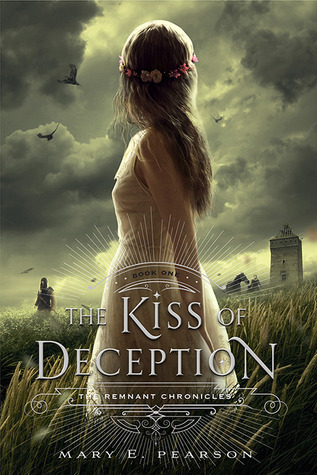
The Kiss of Deception book review

The Kiss of Deception (The Remnant Chronicles #1)

The Kiss of Deception 

by
In this timeless new trilogy about love and sacrifice, a princess must find her place in a reborn world.

In a society steeped in tradition, Princess Lia’s life follows a preordained course. As First Daughter, she is expected to have the revered gift of sight—but she doesn’t—and she knows her parents are perpetrating a sham when they arrange her marriage to secure an alliance with a neighboring kingdom—to a prince she has never met.

On the morning of her wedding, Lia flees to a distant village. She settles into a new life, hopeful when two mysterious and handsome strangers arrive—and unaware that one is the jilted prince and the other an assasin sent to kill her. Deception abounds, and Lia finds herself on the brink of unlocking perilous secrets—even as she finds herself falling in love.


My review: 10/10


This book was nothing like I'd thought it'd be. From reading the synopsis, I thought, Okay. Standard, love story, girl of priviledge wanting to be free of that life, etc etc etc. Nothing new here, completely predictable, but I can accept that if the author can make me connect with at least one, preferably more, characters. Yes, my expectations were extremely low.

About a quarter of the way through, I was thinking, okay well things are progressing along as expecting. Yes it's predictable, but I wasn't thoroughly set on which one she'd choose. I mean, she seemed to have made her choice, but it didn't seem cemented. And what was better, it didn't seem like an easy no brainer for once! While the characters were all likeable enough, what I really connected with was the history of this world and their kingdoms. Typically, I'd get frustrated with a tiny morsel of backstory given here and there at the beginnings of random chapters, in the form of song or poem stanzas etc, like breadcrumbs leading hansel and gretel through the woods toward a big unveiling. I don't have much patience for that. But Ms. Pearson still managed to captivate me with the themes of hunger and magic and the eery nonsense from an unknown land. I happily read on.

About halfway though Ms. Pearson pulled the rug out from under me with a twist I never saw coming. I'm usually pretty good at suspecting these things, or maybe most other authors are just horrible at planting them. I don't know, but she got me. At first, I thought maybe these were typos. I did get an ARC, so maybe it was a mistake. But they just kept coming... how could this many be missed?! I had to accept the fact that I'd been fooled. I was so convinced that at some point, she said something that confirmed my beliefs and it had to be wrong. It had to be incomplete. How could I have been so thoroughly convinced of one thing and then HALFWAY THROUGH THE BOOK find out I had assumed wrong and everything I thought built on that?! I started reading backward, chapter by chapter until I was convinced that Ms. Pearson had Jedi-mind-tricked me, but that I had walked right into it. Oh, so well done. *roung of applause* I loved it. And the result suited my sensibilities better.

I read on and on and on and on. Despite the fact that I was sick, despite the fact that my head was pounding and I had class in the morning. I could not put. it. down.

There were a lot of profound statements in this book, mostly due to their simple truths, like: "It can take years to mold a dream. It takes only a fraction of second for it to be shattered."

I was really surprised that the love triangle seemed to grow and intensify as the book went on. It seemed that the choice should be obvious, why continue to develop an unrequited love? But Ms. Pearson did. And she continued to develop characters and make them make hard choices, she allowed them to grow and to change, naturally. All of the characters seem to have so many layers of depth, the lies and betrayal, I never get to the point where I can safely say I've got them figured out. I can't remember the last time I felt so invested in so many characters' story lines, and then, being a history lover like I am, I can't wait to unravel the mysteries and ancient stories of the people as a whole. It was such a kick to the gut to learn that the next book is not going to be released until 2015. oh, but I cannot wait!

Up until the first half I had intended to give this book 4 stars because it really held my attention and I enjoyed it. But the second half really sold me. This book gets 5 stars, a 10 out of 10 because it is one I will have to own for myself in physical format, so that I can read it again and again and again, each time, seeing things from a different point of view and learning more about their world and my own.

Friday, March 21, 2014

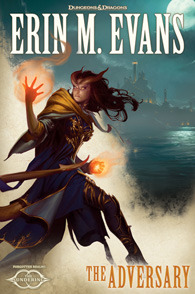
The Adversary: The Sundering, Book III book review


The Adversary (The Sundering, #3)

The Adversary 

by
 
In the 3rd book of the multi-author SUNDERING series kicked off by New York Times best-selling author R.A. Salvatore, the award-winning Erin M. Evans throws her signature character Farideh into a maelstrom of devilish politics and magical intrigue. Captured by Netherese agents and locked away in a prison camp, Farideh quickly discovers her fellow prisoners are not simply enemies of Netheril, but people known as Chosen who possess hidden powers, powers that Netheril is eager to exploit—or destroy. As Farideh’s friends and sister race across the landscape on a desperate rescue mission, Farideh is drawn deeper into the mystery of the Netherese plot alongside two undercover Harper agents. But will her closest ally turn out to be an adversary from her past?


My Rating: 9/10
Jonathan Armstrong


The third book in The Sundering series, which aims to return the Forgotten Realms to a bit of normalcy following some great turmoil, is a great read. Granted, there is not much fighting, and no detailed combat like you would find in a book by R.A. Salvatore, who kicked off the series. But there is power struggle, personal struggle, the threat of violence at every turn, political manipulations to keep readers (and characters) guessing, and refreshingly real characters.

I’ll be honest, the only reason this is not getting a 10/10 is that for the first third of the book, I was not nearly as invested. I was wondering if this book was going to be a disappointment, and combined with the second book of the series, wondering if any of the rest of the books in the series (whose characters I also had never read about) would also not satisfy. The reason was simple. There were too many characters to keep up with, and none to really feel like you knew. This is the danger with having a standalone novel that continues stories of several characters of prior books, but I’m not willing to excuse it. I believe it is a challenge, but not a necessary evil.

So what changed?  Easy. After about a third of the book, we stopped being introduced to new characters via scenes that were often introductory soliloquies. Instead, we got extended portions of text that focused on one character, or at most two or three together, while they were moving the plot. With extended portions devoted to a character or two or three, you got to get to know them, understand them, and identify with them. Their interactions were revealing. History between them naturally arose. How they reacted to events told us infinitely more about them than their soliloquies.

And once we got to the plot of this story, it was tense to the end. After reading about 45% of the book, I couldn’t put it down. I stayed up into the morning reading when I haven’t done that in years. The plot was wonderfully intriguing, and it always left you wondering how all the different parties would play out. They were fractious on so many levels that I haven’t seen that level of detail in even R.A. Salvatore’s work. No one seemed to be on the same side or have the same motives completely. Erin Evans made every character so real, it was incredible.

And that, in the end, is what made this book so amazing, beyond even the plot. The characters. Every character was unique, no matter how large or small their role. I was particularly fond of Farideh and Havilar, the tieflings, because of how they reacted to each other as sisters and also seeing the genuine portrayals of young women (err…tieflings) in them. As a side note, I also really appreciated the view of sex here. It wasn’t taken lightly, and the sister who did partake was still honest as a character since she tends to be more passionate and reckless but not entirely stupid; she did so within a relationship. When Farideh decided to resist Lorcan’s temptations and said she should be praised for her “basic morals”, it was a great turn from what is the current trend in our culture. Our current trend is represented by things like “50 Shades of Grey” where a woman should give into the dark, seedy side of sex instead of holding out for something pure and life-giving. It was greatly refreshing, wherever Farideh eventually ends up on the issue (none of us are perfect!).

Since there weren’t many scenes of violence in the book, I thought I would mention that Erin Evans chose her moments selectively. Every combat furthered a plot, changed a relationship, created an unexpected twist. No violence for the sake of violence (even though I do enjoy a good R.A. Salvatore battle scene). Honestly, I didn’t even notice the lack of violence until this review, especially since the tension from the threat of violence overhung everything. It was very well done and should not put anyone off from this book.

I only hope that Erin Evans can learn from R.A. Salvatore in how he introduces characters in each book (except for Drizzt’s journal entries, please forego those). I first read “The Lone Drow” by Salvatore, the second book of a trilogy and many books into his characters’ development, but didn’t feel lost or uninvested. He introduced them through action and interaction, with their thoughts interspersed between. I didn’t appreciate the difficulty of that enough until I read books two and three of the Sundering.

The honesty and authenticity of Erin Evan’s characters alone would have me wanting to read her past and future books, but combined with the intricately woven plot, I have a new competitor for my favorite fantasy author.

Monday, February 10, 2014

Minding Molly book review

Minding Molly (The Courtships of Lancaster County, #3)

Minding Molly

by
 
Capable and optimistic Molly Zook has a slight issue with control: She doesn't like giving it up. So she's chafing against her mother's wish that, to save the family farm, she marry Mervin Mosier--especially after she meets Leon Fisher. He's from Montana but is working in Molly's district, training horses at a nearby ranch. He is tall and muscular, with a confident demeanor. Molly has never met anyone like him, and he seems to feel the same about her.

Determined to let nothing get between them, Molly decides the best course of action is to get Mervin to fall back in love with her best friend, Hannah. Molly organizes a weekend camping trip hoping to bring them together, but things quickly go awry and it seems Leon and Hannah might be falling for each other instead. Will Molly keep struggling to control everyone and everything around her? Or will she learn to let God handle the twists and turns of her life?


My Review: 6/10
This book works well as a stand-alone novel; when I requested it, I didn't realize that it was part of a series, but never had any confusion or felt like there was too much back story presented. It really is its own individual story.

The story started off very strong with vivid and unique characters. I really identified with Molly in her position as the eldest child with a lot of responsibility on her shoulders, who is bossy, has high standards and seems to break the mold of what it means to be feminine by not having a "normal" reaction to children. My feelings were hurt right along with her when her sister said some of the things that she said. Having a strong personality or being bossy doesn't necessarily give you a thick skin and, when you're not trying to take advantage of people, but just do a good job, being criticized for it, especially by someone close to you, can really hurt.

However, the one thing I disagreed with Molly on (emphatically I might add) turned out to be the whole theme/message of the book. At first, I thought Molly's whole search for love at first sight was just a natural view based on immaturity. I appreciated the tempering stories that showed other perspectives (like her own mother's) and believed, based on the synopsis, that she would learn that love comes in many different forms and would be grateful to receive it in whatever way God chose to bless her. Because of this, and its implications toward Mervin, I felt confused and had barriers up toward Leon for quite awhile.

Then at the end of the book, the author seemed to unravel all the work she had put into showing many different perspectives of love and marriage (her mother telling Molly that she lied earlier and it actually was love at first sight, for example). She just sort of tossed it all aside and started championing this idea of insta-love. That's something I have a serious problem with.

Molly pushes repeatedly for "only marrying for love." Personally, I agree that I'd prefer to be in love with the person before marrying them, but I don't believe it's necessary. I also don't believe that it will necessarily make the marriage stronger or more lasting- a constant dosage of God does that and He puts couples together in a variety of ways and for a variety of reasons. Anyway, Molly seemed to imply that either love was present or it wasn't and that you couldn't have a marriage without it being present. And that, I think, is a lot of the trouble with couples today. Love CAN be controlled. It's not something you're a victim of or something involuntary. It's something that is sometimes present naturally, but more often you have to work at, you have to cultivate, you have to grow with determination. Lawana Blackwell put it very well in her The Widow of Larkspur Inn book:


'And then a question cropped up into her mind from seemingly nowhere. Was love something that suddenly swooped down upon a person, like a cold? She mulled that over for a moment. It did in my case with Philip. But I know now that was only infatuation.
    What if love wasn’t a mysterious “thing” that capriciously attached itself to whomever it willed? Could it be instead a deliberate choice of action? Jesus had commanded His followers to “love one another.” Would He give such a commandment if people had no control over their ability to love?
    And does that mean that romantic love between a man and woman can be cultivated, just as Mrs. Kingstron cultivates her roses?
She recalled standing at a window facing the Anwyl and determining that, like Saint Paul, she would learn contentment. If contentment could be achieved through an act of will, then why couldn’t love? And it would seem that a love purposely cultivated for a man because of his kind nature and comforting ways would eventually grow stronger and deeper than one based on mere physical attraction.'


When Molly talks about love, she really only refers to the way it makes her feel- that's chemistry and attraction. With Leon, it never appears to be built on anything more than a spark. She doesn't talk about his character or values or anything really. Just how good he looks and how she's never 'felt this way' about anyone else. That instant spark, while still a good thing, is not love. Molly never realizes that while that fire can strike instantly like lightning, it can also grow and flame after a lot of work and relationship building (more like rubbing sticks together to build a fire). And I would say that a fire built, rather than instantly ignited, is more stable and lasts longer. I'm not saying that love at first sight never happens or that it can't lead to a successful marriage, I'm just saying that it's not the only way, the normal way or the best way. It's not something to hold out for and value above all other forms, the way Molly does.

Anyway, the other things I didn't like about this book were few and minor in comparison. But I really grew to strongly dislike Hannah. Most of the characters test out their flare for melodrama by crying out "how could you do this to me" now and then, but I thought it was most inappropriate when she responded that way when she was caught flirting with her best friend's beau. Now she's the victim?! I don't respect people who play mind games, so I was not okay with her trying to use Leon to get Mervin back. But it was made a million times worse by the fact that she knew there was something going on between Leon and Molly. Why would she ever think that would be okay? Hannah was just very self absorbed. Molly continually puts Hannah's needs and feelings first, always worrying about her emotionally and mentally, and Hannah takes advantage of that. She's just not a good friend, starting scenes in public, not being there for Molly when she's grieving and not speaking up (but rather talking behind her back to others, like Beatrice) when she thinks her best friend is out of line.

The end came rather abruptly with several characters back pedaling or acting unnaturally for the sake of tying up lose ends, which I just didn't like.

But I really liked the mention of the parallel to the Mary/Marthal. That was such an excellent reminder that God created us all differently and not to judge someone as 'failing' or 'lazy' etc just because they work differently, accomplish different things at different rates or have different strengths. Because we know there is only one Way, I think we often forget that there are many paths to get to Him.

Tuesday, January 28, 2014

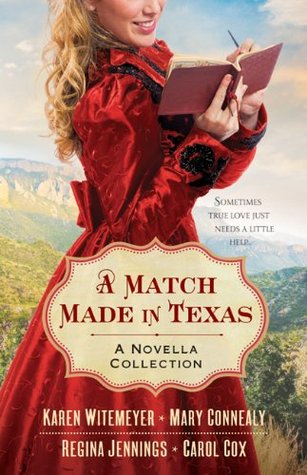
A Match Made in Texas book review

A Match Made in Texas

A Match Made in Texas

by
 
In Dry Gulch, Texas, 1893, a young woman with a tender heart that longs to help those in need takes it upon herself to meddle in the affairs of three acquaintances who are in dire straits. Wanting to stay anonymous, she relies on unusual methods to hire men and women of good character who she thinks can solve the problems facing her “targets.” How was she to know that her meddling would turn into a cupid’s arrow? And what will she do when her friends turn the tables on her with a matchmaking scheme of their own?
Four novellas in one volume


My Review: 7/10

I think Novellas in this genre have a decent shot at being, well, decent. A lot of the things that I complain about when reading historical christian romances (such as: stereotypical characters, way too predictable plots, and drawing out the obvious in attempt to create tension and suspense thereby making the ending sweeter just to name a few) don't really have  the time to develop in a novella. If they do dip into any of these areas, it's easily forgiven due to consideration for length.

When I heard that this was being published and that Karen Witemeyer was one of the authors, I was very eager to get my hands on it. I don't know if I didn't read the plot synopsis very thoroughly or if it's not mentioned, but imagine my surprise when the opening line tells of an Archer's story. !!!! Yay! I thought to myself, cozied up in a blanket with a warm mug of cocoa and snow gently falling outside my window, "it's like Christmas again." Short straw bride was possibly the first book of this kind  that I really fell in love with, because of how different it was. I might have loved Stealing the Preacher even more. My only disappointment with this story is that I believe it's the last of the Archer tales (unless Ms. Witemeyer does something unheard of and writes more stories about them, focusing on their married life. I vote for this!) and I would have preferred a full blown novel to a novella. It's like getting a fun size candy bar instead of a King size.


Surprisingly, I liked  the second story even better. I've only read one other book in this genre featuring a blind woman and it was just awful. This one was very well done and interesting. A couple of parts were a tad melodramatic and cliche (but it's a novella! there wasn't time to flush these things out!) for my taste, but it was different. I didn't feel like I was reading a story I've read a thousand times before, even though I knew where it was going. Reading about how a woman in that time period might approach blindness was very interesting to me. I also liked how Clayton viewed his scars as if they were lit up with fire, yet everyone else noticed them, but were more struck by his good looks. Isn't that the truth? Our perception of ourselves is rather distorted and we often let our insecurities get the best of us. Anyway, I was very pleasantly surprised by this author. I'm going to have to look up some of her other books now.


The third story I was not particularly taken with. This is probably because extreme drama (fires, kidnappings, dirty dealings, really any kind of danger that directly and aggressively threatens a character's life/wellbeing) comes off as very cheesy to me. Rarely do I read a book with one of those events and think to myself, wow. Unless it's a sarcastic 'wow.' On the opposite end of the spectrum, I'm very impressed when daily activities and turmoils are portrayed very honestly and accurately (like Lawana Blackwell's Gresham series for example). Anyway, this story was set up to be more exciting with an unwanted aggressive suitor, potential insanity, frequent threat of being shot, trespassers with ill intent and fire. All of which rubbed me the wrong way. I did learn something though- I had not previously known that you could burn tea. I guess it makes sense since you can also scorch coffee. I just never thought about it before. It's amazing to me, the conveniences of modern life that we never even think twice about, which is one of my favorite things about reading historical fiction- being transported to another time and learning something new.


I almost did not read the last story by Ms. Connealy. I had attempted to read a book of hers before- one of the Kincaid Bride series- and it just was not my taste at all. But I felt it wouldn't be fair to ignore her in this review, nor mention something about how her style isn't my taste, without even giving it a try. So I resolved to take a few tentative steps into the story. My first thoughts were that the language didn't fit the period. But before I knew it, I was really into the story. What sets Ms. Connealy apart is that she allows her characters to have flaws and she allows them to be wrong. Some of the characters development happened too rapidly, but in a short story, an authors options are limited. I wonder how she would approach these themes in a full length novel. I also liked Hannah's resolve to marry a man of faith and how she acknowledged that the really only left one man in town. Her reasons for putting romance on the back burner (and Mark's giving her space) were genuinely good reasons. I actually liked the super fast pace. I feel like a lot of historical romances really drag out major changes and decisions, so the abruptness was refreshing, and also, probably accurate for the time. Life did happen in the blink of an eye. People, family members, did get sick, did die, did marry etc at a much faster pace, usually, than today. A couple other tidbits- I liked that Mark blushed and how their families blindsided them into a shotgun wedding.

There were a couple of things that, though they did not stop me from devouring the story, did take some of the glossiness off.
1. Hannah and Mark's character lines blur a little. They use the exact same phrases (someone moving like a locomotive, and "poor Marcus," "that poor girl," "his poor lip" etc) that sometimes made me feel like I was in the head of one person and not two.
2. Along the same lines, Hannah immediately realizes that Marcus is probably shy, as he acknowledges it to himself. And then, at the end of the story, she seems to have forgotten that and states that she thought he didn't like her and just went out of his way to avoid her. Maybe I misunderstood, but these thoughts didn't seem to match up.
3. Chapter 11- the declarations of love and feelings- was just not my taste. It was too over dramatic for me. I do believe that there are many different degrees of love and that feelings, once sparked and acknowledged can consume like a wildfire. So I'm not saying this would never happen, just that it's not the kind of love story that makes me smile stupidly all day, unless I get to see that story play out for a long while to come (like in Short Straw Bride for example).
4. And this is super minor, but I love historical romances because I like being transported, wholly, back to those times. It bugs me when it's half baked (characters having modern concerns, conversations, goals, opinions etc- like modern people plucked into a different century) and so any anachronisms stick out to me like a sore thumb. The biggest one to me was the conversation about kids at the end of the story. While it's true that not every family was a big one, people did not have control over the number of kids they had like they do today. Maybe the conversation was meant to be more cute than serious, but I just couldn't see it taking place.


I think this is the longest review I've ever written, but considering there were four seperate stories in one, it's not too crazy. All in all, this was a sweet collection of novellas, with my favorite being An Unforseen Match by Regina Jennings.

Monday, January 27, 2014

The Godborn Book Review


The Godborn (The Sundering, #2)

The Godborn 

by
 
In the 2nd book of the multi-author Sundering series launched by New York Times best-selling author R.A. Salvatore, the shadow legacy of Erevis Cale lives on even as his old foe Mephistopheles seeks to stamp it out at any cost. Cale’s son Vasen—unmoored in time by the god Mask—has thus far been shielded from the archdevil’s dark schemes, alone among the servants of the Lord of Light who have raised him since birth.

Living in a remote abbey nestled among the Thunder Peaks of Sembia, Vasen is haunted by dreams of his father, trapped in the frozen hell of Cania. He knows the day will come when he must assume his role in the divine drama unfolding across Faerûn. But Vasen knows not what that role should be . . . or whether he is ready to take it on. He only knows what his father tells him in dreams—that he must not fail.

Enter Drasek Riven, a former compatriot of Erevis Cale, now near divine and haunted by dreams of his own—he too knows the time to act is near. Shar, the great goddess of darkness, looks to cast her shadow on the world forever. Riven has glimpsed the cycle of night she hopes to complete, and he knows she must be stopped.

At the crossroads of divine intrigue and mortal destiny, unlikely heroes unite to thwart the powers of shadow and hell, and the sundering of worlds is set on its course.


My Review of The Godborn by Paul S. Kemp:

7 out of 10

The Godborn is the second book of the Forgotten Realms-shifting Sundering series, following R.A. Salvatore’s The Companions. It follows Vasen, the son of Mask’s chosen, while the main plot resolves the thrice-split divinity of Mask and the world-engulfing threat of Shar’s Cycle of Night.

Paul Kemp is a talented writer. The settings are always well-described, both for sensory and mood; you feel yourself there.  This was perhaps some of the best setting writing I have read. I can see the Abbey of the Rose clearly, the mountain pass, the Sembian plains, Ordulin, Fairelm, etc. Incredibly well done. However, his characters never seemed quite deep enough to me overall. They were deep enough to make the story and scenes work, but not deep enough for the characters to be memorable or for me to care about them, with the exception of Sayeed (of all characters!). While others who have read Paul Kemp’s previous books might think there was enough depth, having never read any of his novels containing these characters before, I didn’t gain quite enough appreciation for them.

Though I didn’t feel enough depth for the characters, they were on the whole rather realistic. The nihilism of Rivalen, the power-crusted but not emotionally impregnable Telemont, the rage-driven Brennus, Vasen’s faith (this was especially good at times), the hatred but loyalty between the two plagueshifted brothers, and it goes on and on. All had realistic motives and were very human. That was another thing wonderfully done. But as I recount all the different characters here, I think I’ve found the reason I was never able to get emotionally attached. I think there were too many characters in this novel; it didn’t allow me enough time with any of them to truly develop an affinity for them. I did want to be fonder of Vasen, since I’m someone of faith and Vasen seemed to be the only main character who strove to bring light into darkness, but it wasn’t to be.

Speaking of which, this book was 95% darkness. This is perhaps another reason that I wasn’t carried away with it. I suppose it should be expected when the two divinities mainly at play are Mask and Shar, and one of the characters who holds a splinter of Mask’s divinity is an archfiend.  I suppose I don’t really blame Paul Kemp for this choice. The plot seems to fulfill its necessary place in the Sundering series. But still, while it didn’t make me like the book less, it did prevent me from liking it more.  I haven’t read his previous books, but there was talk of some characters who probably existed in his prior books and who would have likely counterbalanced the darkness. So perhaps not all his books are like this. If they are, then I would probably count it as a negative.

Finally, the overarching plot:  The most interesting plot was definitely with the plagueshifted brothers. I don’t want to give away any details, but this was a very interesting way to indirectly move events forward. It would have been too easy to move the plot forward directly, which is how the rest of the book seemed to proceed. So while the overall plot was definitely interesting in concept, it was mostly too direct. I feel like I could have read the events factually in a history book or one of the Forgotten Realms supplements (a chapter on how Mask’s divinity was restored into one and Shar’s Cycle of Night was defeated) and not missed much. Giving the benefit of the doubt, I think this storyline got part of its intrigue and suspense and drama from prior books by the author, and so didn’t stand as well by itself. That’s a shame, because this book is a standalone. It continues their story, sure, but it’s not part of a series with those previous books. Overall, this book felt like a conclusion without the beginning or middle.

Overall thoughts:  Paul Kemp’s writing ability is splendid, but I wasn’t as impressed with his ability to craft a story.  Those are two separate things. I would have liked to like this book more, but unfortunately I couldn’t. The plot was interesting in concept, but didn’t get much more interesting for having fleshed it out over a couple hundred pages. This is a shame, because it’s the type of thing I would read a high-level summary of and think “I would love to read the details of that!” In fact, that is how I felt when I got brief snippets of past events involving some of the characters—it made me want to read the previous books. However, given how I felt about this book overall, I’m not sure if I will make the effort to.

Jon Armstrong